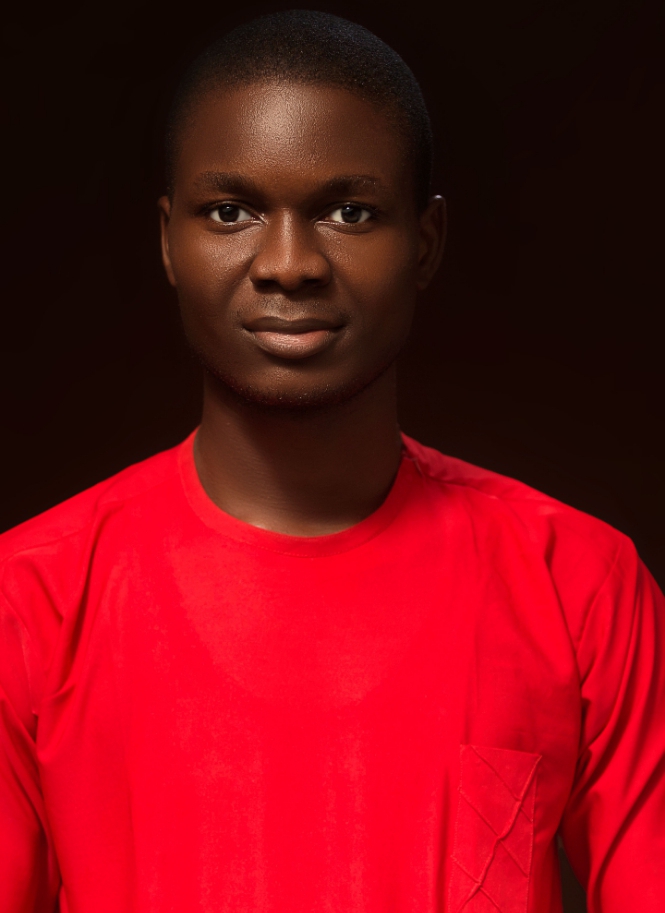
You have a strong connection to storytelling through films and books. I used to think of storytellers only as people who write books, but having encountered the powerful works of people like Genevieve Nnaji, Funke Akindele, Ramsey Nouah, and Toyin Abraham, I have come to expand my definition of storytellers. Could you share with us your definition of who a storyteller is?
Storytelling is both an act and an art. It is an act because it is something we do, and it becomes an art the moment creativity comes into it. In fiction, you see that art in the style, the form and the structure. In film, it is in the shots, the dialogue, the lighting and the score. In painting, it is in the images, the brushstrokes and the colours, and in music, you hear it in the lyrics and the cadence. So, to me, a storyteller is anyone who practises that art, whatever the medium — the novelist and the filmmaker, but also the actor, the painter and the musician. Storytelling is a form of human expression and, I would argue, it is the oldest one we have.
There is often a sense of loneliness that many creatives experience just before they begin to create. In some ways, it seems as though they have to create their art to remind themselves that their lives are connected to the larger world and that they have something to contribute to making it better. Did you have that experience before you began writing stories?
I don't think that loneliness ever goes away. It is part of the creative process, especially with writing, which I find to be a very lonely job. But I believe the reason for writing is unique to each writer. It could be as simple as wanting to write the book you would love to read yourself, rather than needing to remind yourself that your life is connected to the larger world — though, don’t get me wrong, it could be that too. Whatever the reason, it is personal to each writer, and so is the loneliness that comes with it.
Who was your closest confidant when you were a teenager? Did you have that one person with whom you could freely talk about your dreams without pretending to be someone else?
I'm not sure my memory can be trusted to name that one person — if there even was one. Nor can I say for certain what my dreams were as a teenager, though a career in writing definitely wasn’t one of them. What I do know is that I started taking writing seriously as a craft around 2015, and two years later it became my profession when I wrote my first commissioned screenplay.
Calvary Scribblings is a very ambitious project that you founded. Can you talk about why you decided to start it?
Absolutely, and thank you for asking.
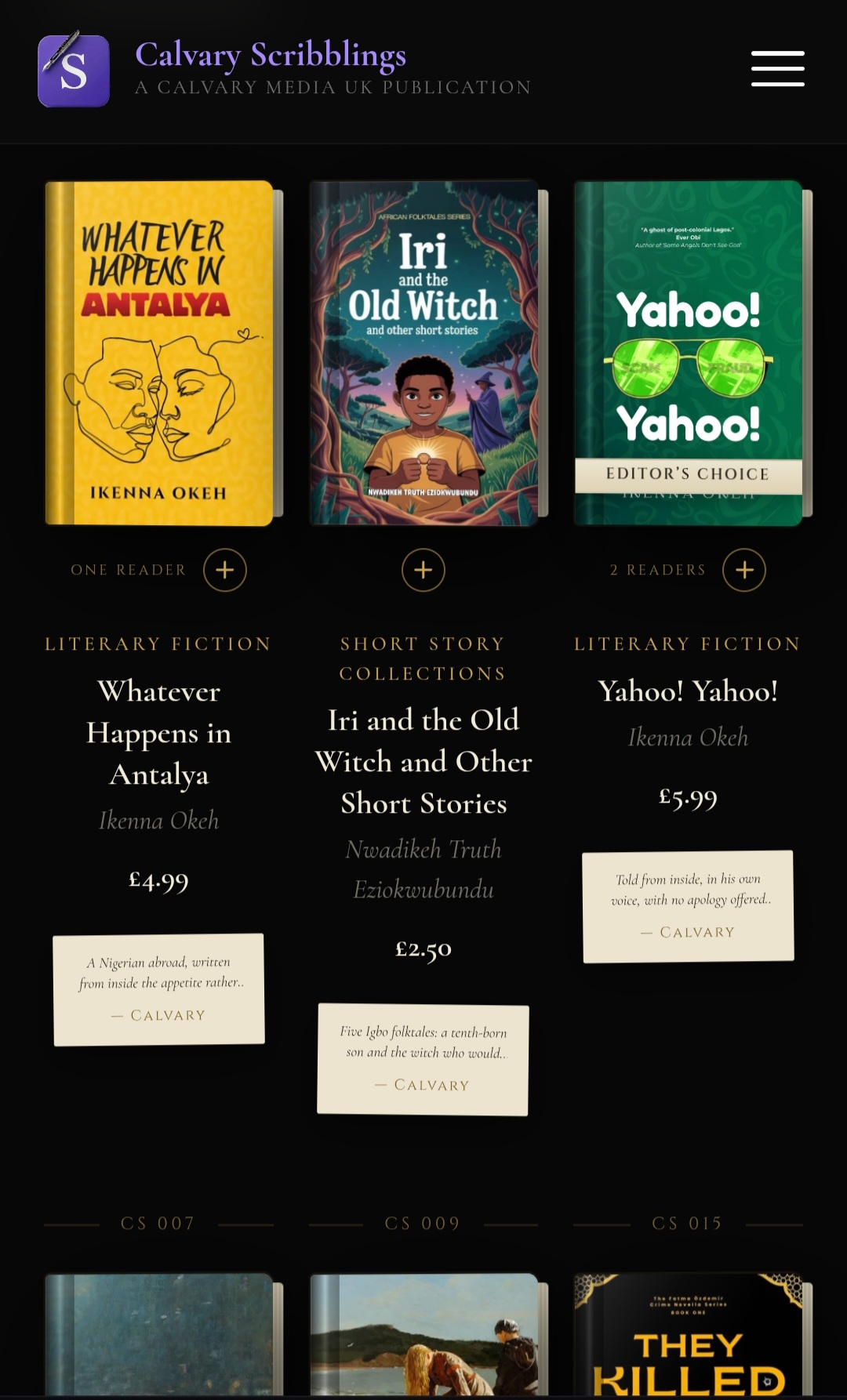
Calvary Scribblings is the publishing arm of Calvary Media in the UK and Calvary Universe in Nigeria. I started it because of two habits of modern life: doomscrolling and short attention spans. I don’t think either will change overnight, if at all, but both go to the heart of literacy. This is our new reality.
So I asked myself, what if I turned those habits to our advantage, with a literary platform that lets you doomscroll through writing of real substance? That was the question that started it all. Then there was the problem of short attention spans, which is where our short-form writing comes in: short stories, flash fiction, poetry and essays. I reached out to a group of writers whose work I had admired for years and shared my plan with them. Thankfully, they came on board.
For the design, I leaned on my filmmaking background and gave the platform a Netflix-style face. The more I worked on it, the more it grew into something truly special. We started as a static HTML website; today we run on a Next.js web app, and our mobile app, Story Island, is on both the App Store and Google Play.
The bookstore came much later. I remembered how hard it was to read Chimamanda Ngozi Adichie’s Zikora in 2020, when I was in Nigeria. The story was an Amazon exclusive at the time, and Nigeria has no reliable access to Kindle, so you had to find a workaround. That gap gave birth to our own digital bookstore inside Story Island, where readers anywhere in the world can easily get hold of books, especially African books.
But what’s a bookstore without books? So I reached out to Mr. Ikenna Okeh, the director of Linea House Publishing, pitched our bookstore to him and invited him to bring Linea’s titles to us. He graciously bought into the idea and committed eleven Linea House titles to Story Island. There and then, I knew we had a bookstore.
I am incredibly proud of how far we have come. Sometimes I forget we are less than a year old because of how much we have built. I am eternally grateful to everyone who has supported us, especially our writers and readers. This journey is just getting started — I promise you.
Why did you choose the name Calvary Scribblings?
That’s an interesting question. ‘Scribblings’ is the obvious half: it comes from ‘scribble’, which is to say, writing. ‘Calvary’, the umbrella name for all our companies, comes from a character in a novel of mine that hasn't been released yet. That character, Calvary, got his name from a book he wrote — a book within the book — called Place of the Skull. And what is the Place of the Skull? It is where Jesus Christ was crucified: Calvary. That is why most people associate the name with religion, and they are not wrong, but religion was far from my mind when I chose it. For me, it was the wordplay — the intricacy of where the name came from.
So Calvary, as the parent company, now runs Calvary Scribblings for publishing, Calvary Films for production and Calvary Radio for broadcasting.
The fear of piracy is real, so I understand the hesitation. But publishers have nothing to worry about. We treat every title with the utmost care, and we have built the platform to make piracy as hard as possible.
It is encouraging to see the continued existence and, perhaps, growth of African literature today, although there is still a lot to be done. Readers have borne witness to the growth of literary magazines and platforms such as Brittle Paper, The Kalahari Review, and Lolwe, as well as publishing houses such as Farafina Books, Cassava Republic, and Masobe Books. Sometimes, we focus on the successes of these projects but overlook the challenges of running them in Africa. Could you talk about the challenges you faced when Calvary Scribblings was starting out and those you are facing today?
In the beginning, the biggest challenge was navigating the idea phase — making sure I had a clear understanding of what I wanted to put out into the world. Finding the capital to start something as ambitious as Calvary was a major challenge too.
Today, the biggest challenge is marketing. We have been doing all we can to spread the word about what we are building, but we need to double down, and doubling down means putting more money into it. We hope to do that once we raise our seed round in the first quarter of next year. So, if you are an investor looking to build something special, look no further: you have found a home with Calvary Scribblings.
The other challenge is trust. Not every publisher is Mr. Ikenna Okeh, who was simply phenomenal in the way he threw his support behind us by listing Linea’s titles with us. We have reached out to independent and traditional publishers to host their books with us, and so far only a handful have been willing to engage. The fear of piracy is real, so I understand the hesitation. But publishers have nothing to worry about. We treat every title with the utmost care, and we have built the platform to make piracy as hard as possible. For example, you can’t download a book from our store as a file. You buy it on our website, it lands in your library, and from there you can read it anywhere — on the web or in the app — but only inside our reader. The app keeps a copy for offline reading, but that copy stays inside the app. You can’t even take a screenshot of a page while reading in the app, the same way Netflix blocks screenshots of the films you stream. So we have put guardrails in place to make sure the work authors and publishers entrust to us doesn’t end up in the wrong hands.
Readers saw the emergence of OkadaBooks in 2013 and bore witness to how accessible it made Nigerian literature. I would like you to talk about what Calvary Scribblings does differently to bridge this gap and make reading more accessible to people today?
As I said earlier, the platform grew out of the problems I described. I try not to look at what we do through the prism of other companies; we are simply committed to what we are building at Calvary Scribblings. We believe we have a solid product. Our short-form writing gives readers a quick win every day. Our bookstore gives you access to African literature, as well as classics, at very low prices. We price our books in naira, pounds, and dollars, so readers in Nigeria can pay in their own currency through Paystack, without needing a dollar card. And the Square, our community room, opens every evening from 8pm to midnight, UK time, so readers can meet and talk about the stories they have been reading.
I know OkadaBooks well; in fact, I published on the platform at one point in my writing career, and it was sad to see it close. But every platform’s journey is unique, and at Calvary Scribblings we intend to keep working and keep finding exciting new ways for our readers to enjoy literature.
In 2017, your short story Sunburn was adapted into a film produced by Nosa Obaseki. How did that adaptation open your eyes to the possibilities available to you as a storyteller?
Nosa Obaseki has been an amazing friend over the years. When he reached out about adapting Sunburn — a short story inspired by the Ed Sheeran song of the same name — I jumped at the offer even though I didn’t have the first idea what a screenplay was supposed to look like. So, I turned to the internet to learn how to write for the screen and came back to my desk with a fair amount of knowledge and a screenwriting template for Word.
That single collaboration, which included co-writing with Emmanuella Dunia, catapulted me into the film world, and I found myself expanding my reach and my network. It became clear to me that I had found a home in the creative space. I leaned into it, and six years later I was studying for an MA in Screenwriting at the London Film Academy.
We should be striving to own what we make, invest in our own distribution and support our own (...) platforms.
You have gone on to write and produce films. What progress have you seen in Nollywood as an industry, and what more do you think needs to be done to make this trajectory sustainable?
Nollywood has made huge progress in picture quality. It’s incredible what we can now do with cameras; it’s a joy to see. But we still haven’t got a firm grasp of our storytelling or our distribution — especially our distribution. When Netflix and Prime Video arrived, we thought we had finally made it. But Prime Video stopped funding African originals in 2024, and Netflix has since scaled back the Nigerian originals it commissions. In hindsight, we shouldn’t have pinned so much on them.
I am a big believer in ownership. We should be striving to own what we make, invest in our own distribution and support our own streaming platforms. Believe it or not, a good number of them exist, and they are respectable platforms with good films: Oracle Films TV, which carries as many as seven of my own films; Kava, co-run by my fellow screenwriter Chinaza 'Naz' Onuzo; and EbonyLife ON Plus, the streaming platform of Mo Abudu, who recently opened a cinema for African films and events here in London. These are really good platforms, and we should be investing in them.
Nollywood has a lot of potential. We just need to harness it and be intentional about it.
What is the difference between telling a story in a novel and telling one on screen?
The difference has always been in the telling. Where a screenplay is a blueprint for production, a novel is more like a detailed journal. A screenplay is always written in the present tense and gets straight to the point: no backstory and no detailed description unless the scene demands it. Screenplays are also strict about formatting. Scene headings (or sluglines), action lines, character names, parentheticals, dialogue and transitions are unique to the form, and you must follow them to the letter if you ever want your script to be taken seriously.
A novel, on the other hand, is a writer’s playground. You get to sit with an idea, expand on scenes, do a lot of showing and bring in sensory detail. And a novel can take many forms, in whatever tense you choose.
Finally, which novelists have influenced your writing the most?
In an attempt not to give you a long list, I will just go through a few. Chimamanda Ngozi Adichie has been a very influential novelist in my journey. I tried to get into a few of her workshops but never made it — bummer. Chinua Achebe, of course: the master himself. Discovering Ikenna Okeh’s work has been a blessing. His vivid use of language has had a big influence on my writing, and I love that he is so prolific.
Nora Roberts, the romance goddess. Her Genuine Lies is one of my favourite works of fiction out there. Genius.
I have only read one book by Daniel Keyes, and that is Flowers for Algernon — please don't read it, unless, of course, you want your heart broken to smithereens. That book taught me a lot about structure, form and the way stories and characters evolve. I want to read Keyes again, and soon.
I adore Abubakar Adam Ibrahim’s writing — he’s so good! — I’m looking forward to reading ‘Damage’. George R. R. Martin, the Game of Thrones guy: an amazing writer — legend. Nicola Yoon did something to me with The Sun Is Also a Star — a brilliant book by an amazing author. I can’t keep quiet about Jojo Moyes either — what an absolute legend.
And I am telling you right now, you have to go and read Jodi Picoult. The incredible Jodi Picoult.
Toni Morrison grounds me with her prose. I am learning pacing from that woman’s work. My stories are usually very fast-paced, but I have been learning to balance the speed, and Morrison’s work has helped a great deal. Stephen King and James Baldwin are two more whose prose is on a par with Morrison’s. The three of them write as if they were specially ordained by God Himself.
I’m currently reading Somi Ekhasomhi’s The Only One, amongst other titles on my reading list, and I find her a very talented writer. Just brilliant!
Kevin Kwan's Crazy Rich Asians trilogy was a masterclass in writing and storytelling, and so was E. L. James’s Fifty Shades series. Blessed writers.
Then there’s Michael Connelly, Chimeka Garricks, John Grisham, Dan Brown, Nicholas Sparks, Elif Shafak, John Green, Ernest Hemingway, Michelle Hodkin, Zadie Smith, Gabriel García Márquez and a host of other very talented authors. I am sure I will be beating myself up when I read this interview and find I have missed a bunch of names, but that’s all right. Haha!
Ikenna Okpara’s Nollywood-inspired debut novel, Love Letters, published by Linea House Publishing, is set for release on November 19, 2026.
You can pre-order your copy from Tiny Dot Bookstore.